
Tagged: ATN


The Stone of Odin
Until the winter of 1814, the holed monolith stood to the north-west of the Stones of Stenness. But although its special place in the customs, traditions and folklore of the people of Orkney is well documented, we know remarkably little about the stone itself. Read more

The knowes, howes and barrows around the Ring of Brodgar
Although the Ring of Brodgar dominates the surrounding area, the stone circle is but the tip of an archaeological iceberg. Read more

The Barnhouse Stone
A solitary lichen-crowned megalith stands in a field about half a mile to the south-east of the Stones of Stenness. Read more

The Deepdale Stone
Head north along the road south-west of the Stenness loch and a single standing stone will be clearly visible on high ground to the north-west. Located in the parish of Stromness, the Deepdale Stone stands 1.8 metres (6ft) high. Read more

The Barnhouse Settlement
In December 1984, evidence of a Neolithic village was found 150 metres (164 yards) to the north of the Stones of Stenness, at the southern end of the Harray loch. Read more


The Stones of Stenness
The second stone circle in the Heart of Neolithic Orkney World Heritage site is now most commonly known as the Stones of Stenness. Read more

Unstan stalled cairn, Stenness
In the late 19th century, the Knowe of Onston was opened and found to contain the remains of a Neolithic stalled cairn. Read more

The Ring of Brodgar
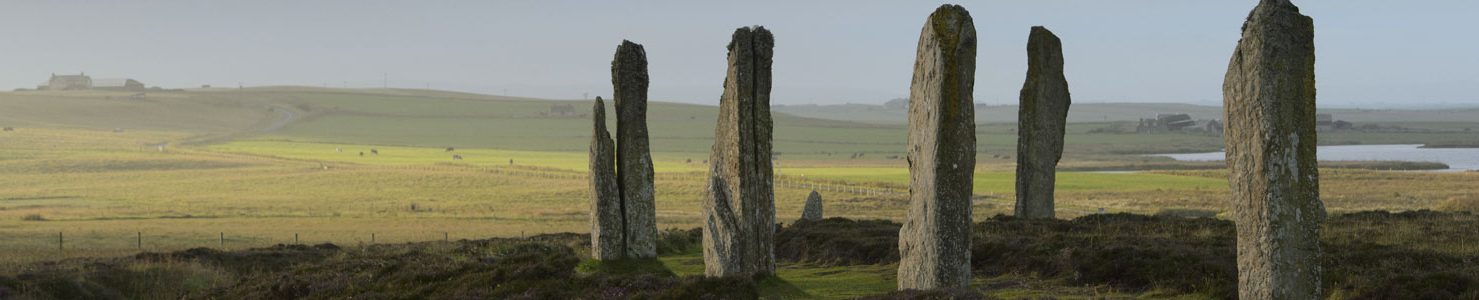
With a diameter of 103.6m (340ft), the Ring of Brodgar is the larger of the two stone circles in the Heart of Neolithic Orkney World Heritage Site and one of the biggest in the British Isles. Read more

The ‘Little Barnhouse’ mound
Just outside Stenness village, and opposite the Standing Stones Hotel, is a large oval mound. The tumulus was given scheduled monument status in 2002 and assigned the name “Little Barnhouse”. Read more

The Comet Stone
On low ground 140 metres (153 yards) east of the Ring of Brodgar is the monolith now commonly known as the Comet Stone. Read more

A natural cursus? Water, walls and walking the Ness
Previously we saw that the Dyke of Sean was perhaps once one of three — or possibly four — walls that ran the width of the Ness of Brodgar in the Neolithic. Did these define specific areas – dividing the isthmus into distinct segments of “graded” space – and controlled movement and visibility through them? Read more

The Dyke of Sean – a third monumental wall crossing the Ness
The Dyke of Sean, a suspected prehistoric earthwork near the Ring of Brodgar, fascinates visitors with its monumental size. It measures up to seven metres wide and a metre high, spanning 500 meters between the Stenness and Harray lochs. Despite unclear dating, masonry suggests a Neolithic origin. Read more

The Watchstone
One of Orkney's most imposing standing stones, the Watchstone dominates the south-eastern end of the Brig o’ Brodgar – the place where the Harray and Stenness lochs meet. Read more

Ness flanked by lochs in prehistory? Surveys suggest otherwise
The Ness of Brodgar sits at the centre of a massive natural "cauldron" formed by the hills of the surrounding landscape. Today, it is accentuated on either side by the freshwater Loch of Harray and the saltwater Loch of Stenness - but that was not always the case. Read more


