Category: Chambered Cairns
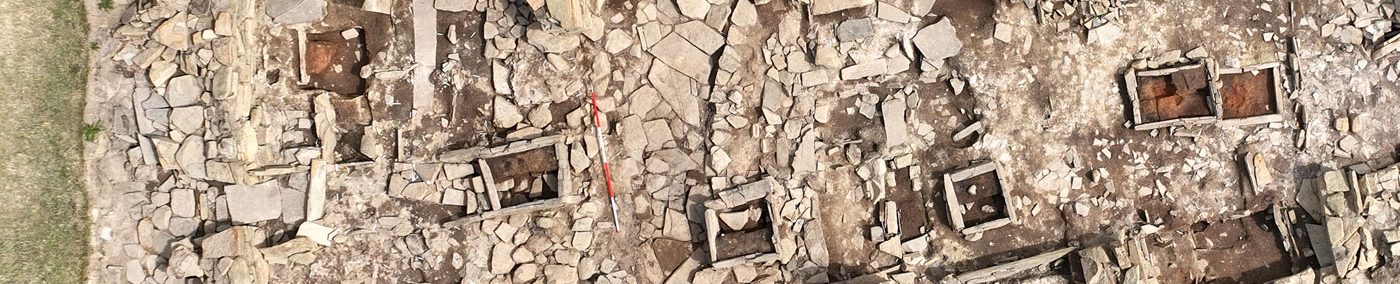
At some point in the Neolithic a small, multi-chambered structure was built on high ground at the north-western end of the Ness of Brodgar. Read more
Link: DNA suggests genealogical links between Caithness and Orkney tombs
A new paper looking at the DNA of human remains in Caithness and Orkney chambered cairns has been published in the journal Antiquity. Read more
Video: Professor Colin Richards on death and burial in Neolithic Orkney
A pair of videos from Professor Colin Richards, created for the UHI Archaeology Institute's Tombs of the Isles project. Read more
Video: The dead of winter – Maeshowe and the solstice
Today, Saturday, December 21, is the winter solstice - a day inextricably linked to Maeshowe in Stenness. Read more
The Knowe of Rowiegar – Neolithic burials with Iron Age modifications
The Knowe of Rowiegar, Rousay - built in the Neolithic and re-used in the Iron Age. Read more
First of the planned Tomb of the Eagles updates now online
The first of a series of updates looking at the Isbister stalled cairn in South Ronaldsay - the Tomb of the Eagles - is now online. Read more
Maesry – another Maeshowe-type chambered cairn in Sanday?
Maesry is a suspected Maeshowe-type chambered cairn on Start Point - a small tidal island off the north-eastern tip of Sanday. Read more
New photographs added to Quoyness and Egmondshowe pages
Work in Sanday recently gave me the chance to update my photo library - some of which have now been to the Quoyness chambered cairn and Egmondshowe pages. Read more
Braeside, Eday – two structures covered by a single cairn?
A stalled chamber within a substantial cairn - was there a second structure at the northern end? Read more
Two-storeys and partially underwater – the Huntersquoy chambered cairn
A look at (with a little bit of speculation) the remarkable Huntersquoy chambered cairn in Eday - one of only two known two-storey cairns in Orkney. Read more
Video: ARP 2025 – ‘(Re)discovering a Neolithic passage grave at Blomuir, Holm, Orkney’
The recording of Dr Hugo Anderson-Whymark's talk on the Blomuir chambered cairn, Holm, at the Archaeological Research in Progress 2025 conference. Read more
New ORCA report details 1985 Vinquoy excavation for the first time
The UHI Archaeology Institute has published a report of the 1985 re-excavation of the Vinquoy Hill chambered cairn, dedicating it to the late Jacqui Marwick, the archaeologist who led the operation. Read more
Video: Update on 2024 season at Blomuir chambered cairn now available
The recording of Dr Hugo Anderson-Whymark's Orkney Archaeology Society talk the 2024 excavation season at the Blomuir chambered cairn is now available. Read more
Vinquoy chambered cairn, Eday
We begin a series of posts looking at the Neolithic in Eday with the Vinquoy chambered cairn. Read more
Trust’s £357k award sees ‘Tomb of the Eagles’ purchase move a step closer
Plans to reopen the Isbister chambered cairn took a step closer this week with the Scottish Land Fund awarding £357,705 to the South Ronaldsay and Burray Development Trust. Read more
Maeshowe – the mummies, the giant and the mound-dweller…
A look at what may have lain behind the 1861 newspaper claim of two mummies and a giant in Maeshowe. Read more
Isbister cairn – the human remains
Isbister was one of the few Orcadian chambered cairns found to contain human remains – in this case, in such quantities that it was declared “the largest assemblage … from any single British Neolithic site.” Read more
The Isbister stalled cairn – South Ronaldsay’s ‘Tomb of the Eagles’
The first part of an article looking at the Isbister stalled cairn in South Ronaldsay, better known today as the Tomb of the Eagles. Read more
The Knowe of Lairo – remodelled to emulate Maeshowe or something completely different?
This week we're looking at the Knowe of Lairo in Rousay - another enigmatic Neolithic chambered cairn unlike any other in Orkney. But what was going on? Read more
Link: New research suggests differing mortuary practices in Rousay cairn
A new paper looking at the bone assemblage from the Rousay’s Knowe of Rowiegar suggests that human remains were placed at different stages of decomposition in a more complex, muti-stage process for handling the dead. Read more