
Windwick and the world beneath: rethinking Orkney’s earth-houses

By Sigurd Towrie
In 2003, Martin Carruthers, of the UHI Archaeology Institute, began a three-year excavation project at Windwick Bay, South Ronaldsay. Following the recent discovery of a potential souterrain at the Ness of Brodgar, I caught up with Martin, 21 years later, to hear the latest on this remarkable site.
As most known Orcadian earth-houses were discovered before the advent of modern archaeological techniques, the Windwick excavation offered a rare opportunity to investigate an undisturbed example in detail, shedding light on how such structures were built, used and ultimately abandoned.
What emerged was a structure that appeared to be as much concerned with “ritual” activity, and particularly the dead, as with being a place to stash that season’s crops.
The Windwick earth-house did not exist in isolation. It formed part of a wider prehistoric landscape centred on Windwick Bay, an area that contains a remarkable concentration of later prehistoric archaeology. Just 500 metres to the north-west lies The Cairns, an important Iron Age broch and settlement complex that has been under excavation since 2006.
Together, these sites demonstrate that the bay was a focal point for community life over many centuries, with settlements, ceremonial structures and underground chambers forming part of an interconnected archaeological landscape.
Modern research has increasingly sought to understand not only the individual monuments themselves, but also the relationships between them and the people who built, used and revisited them over time.
Although the earth-house had originally been discovered in the late 19th or early 20th century, it was covered over when the land was brought under cultivation. It was rediscovered in 1934 when a plough struck a roof lintel, revealing a dry-stone-built chamber approximately 1.8 metres deep and 9.7 metres long, aligned north-east to south-west, with a small cell at either end.
After its rediscovery, the structure was left intact and the entrance passage filled in. It remained undisturbed until the 2033 excavation, when archaeologists discovered that the underground chamber and an associated above-ground building had been designed and constructed together, probably around 600BC and abandoned around 300BC.

The upper building was entered through a south-east-facing doorway, but the absence of domestic features, such as a permanent hearth, suggested it was not a dwelling – at least not in the normal sense. Once inside, visitors would have been immediately aware of the structure beneath their feet. The clay used to cap the roof of the earth-house was a noticeably different colour from the floor surface of the building above, clearly marking the outline of the underground chamber.
The design of the upper building also controlled movement.
Internal stone divisions guided visitors around the structure in a clockwise direction before they could enter the earth-house. In later Orcadian tradition, clockwise, or “sunwise”, movement was associated with life, prosperity and well-being.
Once inside the subterranean chamber, however, movement became anti-clockwise, or against the sun, creating a striking symbolic contrast between the worlds above and below ground.
It also became clear that the earth-house served a role beyond simple storage. Although there was no formal hearth in the building above, traces of temporary fires were found within the chamber itself. Pits cut into the floor contained cramp, a glassy slag-like material, together with cremated human remains.
Among the cremated material were fragments of steatite-tempered pottery. As steatite, or soapstone, does not occur naturally in Orkney, the vessels must have been imported. While steatite is found on the Scottish mainland, the form and style of the vessels suggest that Shetland was their most likely place of origin.
Petrological analysis of the sherds by the University of Glasgow showed that the pottery was made from clay gathered around a weathered steatite outcrop. The steatite-rich temper was therefore naturally incorporated into the clay used to form the vessels, rather than being added later as crushed stone. This strongly suggests that the pottery arrived in Orkney as finished vessels, rather than being manufactured locally using imported steatite.
The effort involved in obtaining and transporting these vessels may indicate that they held particular significance. Their presence among the cremated material raises the possibility that they were brought to the site specifically for funerary or ceremonial purposes.

Additional cremated deposits were discovered within the earth-house roof, deliberately incorporated into the structure during its construction. These finds point towards carefully planned symbolic acts rather than accidental deposition.
Pushed into the earth-house’s clay capping was a reworked lignite bangle fragment – another import to Orkney. It had been broken and refashioned into a little axe-like object, which assessment by Fraser Hunter at National Museums Scotland suggests may have been an amulet.
Withing the chamber were broken saddle querns and rubbing stones. While these are normally associated with everyday domestic activities, their presence in what appears to have been a ceremonial space raised intriguing questions.
The cremated material had been reduced to a very fine consistency, suggesting the querns were used to grind the remains before being deliberately broken – ritually killed perhaps? Were they seen as somehow polluted? Associated with, or touched by, the dead?
As well as the bone, the querns had also been used to grind cereal grains. Meanwhile some stone tools seem to have been fashioned inside as well. The narrow, low ceilinged crawl-space seems like a highly inconvenient space to do any of this vigorous activity and that may mark these tasks out as special in some way – activities requiring a measure of privacy, perhaps even furtive secrecy.
At the end of its life, the earth-house appears to have been deliberately decommissioned and sealed. As part of this a rectangular pottery vessel was placed within the material used to block the entrance, indicative of a final ceremonial act before the structure was abandoned.One of the few artefacts disturbed from the rubble infill in the 1930s intervention was a large part of a straight-sided steatite vessel, now lost.
The significance of the cremations remains uncertain. One possibility is that they were gathered from earlier burials and incorporated into the earth-house as a means of connecting with ancestors. This interpretation fits wider evidence from across Orkney, where Bronze Age and Iron Age communities reused older Neolithic monuments while often taking care not to disturb the original burials, suggesting a continuing respect for ancestral places.
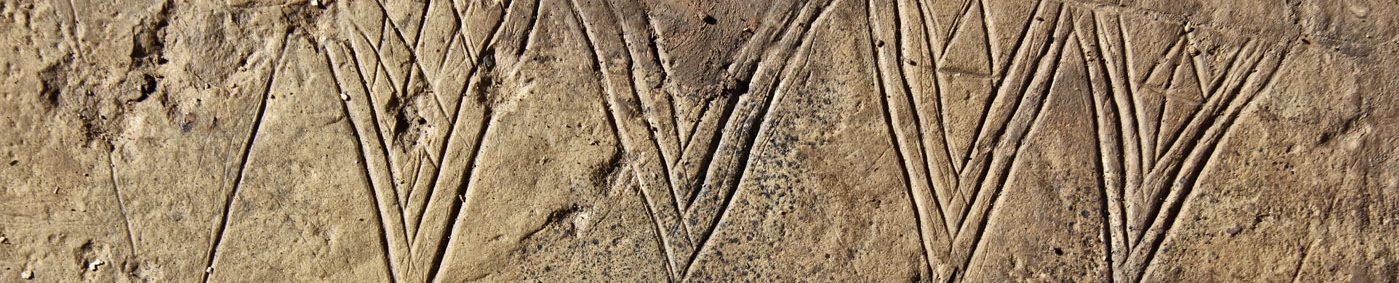
Evidence for links with the distant past also came from a large lintel stone within the earth-house. The stone bore eight circular cup marks, although these were hidden beneath the clay roof cap and would not have been visible during the life of the structure. Beneath the clay covering archaeologists also identified ancient plough marks, suggesting that the stone may have been incorporated into the earth-house because it was part of an earlier, possible Neolithic, structure.

So what does Windwick tell us about Orkney’s earth-houses?
It reminds us that souterrains were not just the equivalent of food storage pits of the kind often found from Iron Age sites in southern Britain but were architectural spaces within which human beings undertook potentially important tasks, preparing and processing culturally sensitive materials.
Souterrains were not just passive storage spaces but, based on the evidence from Windwick at least, may have been the scene of active tasks.
Although these may have been connected to beliefs surrounding death, ancestors and remembrance, it does not mean they were used as “tombs” or places for storing human remains. Instead, they may have been regarded as symbolic underworlds, spaces set apart from the everyday world of the living with their own distinct role and significance to those who used them.
Rather than contradicting evidence from other Orcadian earth-houses, the Windwick excavation encouraged a re-examination of earlier discoveries. Most sources cite the Rennibister earth-house as an anomaly because it contained human skeletal material. A closer reading of historical records, however, indicates that evidence for human remains may have been more widespread than previously recognised.
To Martin, earth-houses have architectural traits that show a clear connection to the underground “wells” found in some brochs, as well as Minehowe. This suggests a shared tradition in which underground spaces played an important ceremonial or symbolic role.
This interpretation shifts the focus away from purely practical explanations and towards ritual activity. One possibility is that earth-houses were used for rites of passage, such as initiation ceremonies or transitions into adulthood. Anthropological studies show that such rituals often involve isolation, darkness, sensory deprivation and other controlled experiences. In this context, the earth-house may have provided a symbolic journey between the world of the living and the realm of the ancestors.
Used intermittently, as and when required, rather than being occupied permanently, these structures could still accumulate domestic objects and debris over time. The evidence from Windwick therefore points to a more complex role for Orkney’s earth-houses: places where ritual, memory, ancestry and community identity came together beneath the ground.
While the Windwick excavation provided compelling evidence for ceremonial activity, the purpose of Orcadian earth-houses remains debated. Rather than serving a single function, these structures may have fulfilled practical, social and ritual roles that changed over time.


