
The Grain earth-house, Kirkwall

To the west of Kirkwall Bay lies the subterranean chamber known as the Grain Earth House. Today, it is easily overlooked. Situated in the heart of an industrial estation, the monument appears from the surface as little more than a fenced-off grassy mound.
Beneath this unassuming knoll, however, is one of Orkney’s finest surviving Iron Age earth-houses. Thought to have been constructed and used during the latter half of the first millennium BC, the chamber survives almost intact around two metres below the present ground surface.
The earth-house was first discovered in 1827, when the surrounding area was still open farmland lying beyond the outskirts of Kirkwall. At that time, the monument was sealed and left undisturbed until 1857, when the antiquaries James Farrer and George Petrie decided to explore.

Access to the main chamber is by a flight of stone steps descending to a gently curving, underground passage approximately five metres long. At the foot of the stair are two small wall recesses, the purpose of which remains unknown.
Unusually, much of the original entrance arrangement survives, offering a rare insight into how the structure was entered in the Iron Age. Only the upper section of the stair is modern, having been reconstructed after the site passed into state care around 1908.

Both passage and chamber are roofed with substantial stone lintels, while four massive upright pillars support the roof of the main bean-shaped chamber. The pillars stand approximately 1.5 metres high and support a roof that lies around two metres beneath the modern ground surface.
Although Farrer and Petrie left no detailed account of their excavations, they found the chamber itself to be empty. Above ground, however, they uncovered traces of what they interpreted as a domestic settlement together with a substantial midden deposit. These discoveries hinted that the earth-house formed part of a larger settlement complex rather than existing in isolation.

(📷 Licensed by Paola Arosio and Diego Meozzi (Records of the Scottish Cultural Resources Access Network (SCRAN), Edinburgh, Scotland))
That interpretation was strengthened in 1982, when excavations revealed a second earth-house approximately six metres to the west. This structure was “almost identical in size and
construction to the guardianship one [Grain].” [1]
The archaeologists also identified the remains of an Iron Age building overlying the newly discovered structure, along with fragmentary traces of additional buildings nearby.
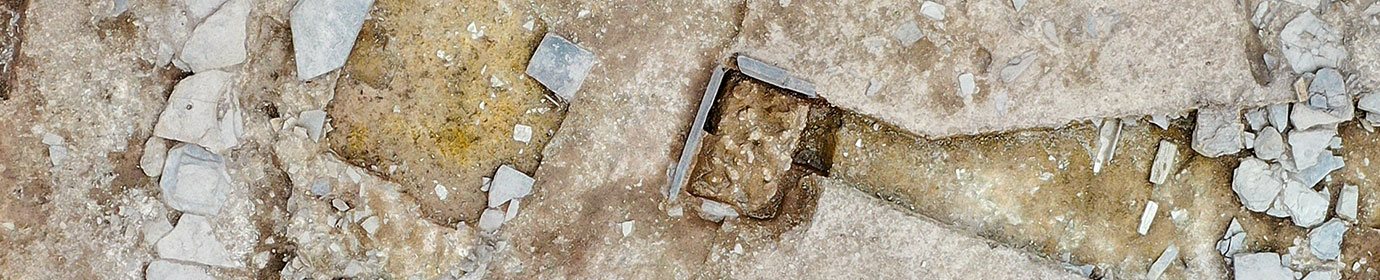
After abandonment, this chamber was infilled before being being blocked-off with a row of upright flagstones. And interesting element was that a new chamber was then constructed, which may have been “entered from the guardianship earth-house to the [east], and that the
connecting passage was later blocked up.” [1]

Taken together, the evidence suggested that both earth-houses were integral elements of a wider settlement occupied during the Iron Age, reflecting a pattern seen at other Orcadian sites where earth-houses seem to occur alongside other structures.
While the 19th-century exploration produced no artefacts from the main chamber, the 1982 investigations recovered a diverse assemblage of finds, including 86 pottery sherds, fragments of worked antler and animal bone from birds, fish, dogs, cattle, pigs and sheep. A bone bodkin, an antler weaving comb, a pivot stone and two hammerstones were also found.
These objects point to a community engaged in a range of domestic and craft activities and reinforce the close relationship between Orcadian earth-houses and the settlements within which they were built.
As with earth-houses elsewhere in Orkney, the evidence suggests that the Grain structures were part of the everyday life of the settlement, although their precise role within Iron Age society remains a matter of debate.
Notes
- [1] Haigh, D. and Smith, B. (1984) A second earth-house at Grainbank, St Ola, Orkney. In Proceedings of the Society of Antiquaries of Scotland (Vol. 113, pp. 367-372).


