
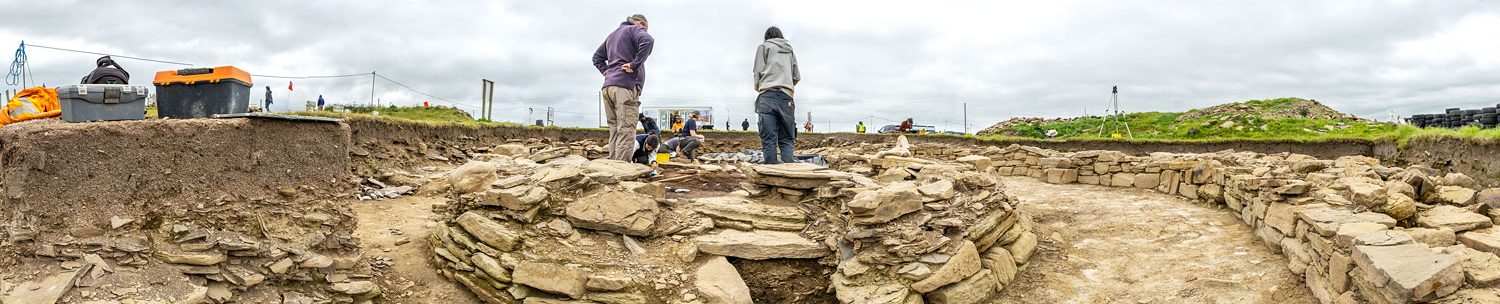
Delving into earth-houses – a subterranean prehistoric enigma

With geophysics now suggesting an underground chamber in the Trench T midden mound, at the south-eastern end of the site, we though it worthwhile to take a closer look at Orcadian “earth-houses” and, in the coming week, a few examples.
The “earth-house” is one of Orkney’s more enigmatic prehistoric structures. Better known elsewhere in Britain as souterrains, Orcadian earth-houses [1] date to the Late Bronze Age and Iron Age and typically comprise a long stone-lined passage leading to a circular or oval chamber.
While some souterrains elsewhere in Britain are partially visible above ground, Orcadian earth-houses are entirely subterranean. In some cases, such as the Grain Earth House near Kirkwall, the chambers lie several metres below the modern ground surface, accessed by narrow, often awkward passageways.
A glance through the records shows that earth-houses were fairly common discoveries over the years. However, only two, at Grain and Rennibister, are open to the public.

Despite their numbers, earth-houses remain one of the enduring mysteries of Iron Age Orkney. Why they were built, and how they were used, however, remains a topic of debate. In 1926, the discovery of the remains of 18 people in the Rennibister earth house in Firth really muddied the waters.
For many years, earth-houses were generally interpreted as ancillary structures associated with nearby settlements. Because they were often found alongside buildings that were interpreted as domestic, it was assumed they functioned primarily as storage spaces, perhaps providing cool, stable conditions for preserving foodstuffs or agricultural produce.
Yet this interpretation has never been entirely convincing.
There is little direct evidence for the storage of crops or other goods in Orcadian earth-houses, and their architecture does not always lend itself to frequent, practical use. The narrow entrances and confined underground chambers can make access difficult even for modern visitors.
The majority of known earth-houses were found in the 19th and early 20th centuries. The few modern excavations have challenged the idea that they were simply prehistoric storerooms. Excavations in South Ronaldsay, particularly around Windwick and The Cairns, produced evidence suggesting a more complex role, perhaps including mortuary practices and the commemoration of the dead.
Cremated bone fragments from Windwick, when considered alongside the deposition of human remains at Rennibister, suggest that earth-houses may have been places where the worlds of the living and the dead intersected, serving ritual or ceremonial functions as well as any practical purpose.
Perhaps not just underground annexes to domestic settlements but places imbued with social, symbolic and ritual significance – their dark, subterranean chambers providing powerful settings for acts of remembrance, ancestral veneration and other practices linked to Iron Age communities.
From what has been found in modern excavations, and looking again at the early accounts, it does seem that earth-houses were, in some way, associated with the dead. But this doesn’t automatically mean they were used to store, or inter, human remains.
Instead, were the chambers seen as symbolic “underworlds”? Places apart from the realm of the living, with their own distinct role and significance to those who used them.
Although this appears to contradict the earlier excavations of earth-houses in Orkney, work by Martin Carruthers, of the UHI Archaeology Institute, has shown this not to be the case. Most sources cite the Rennibister earth-house as an anomaly because it was found to contain human bodies. But re-examining early reports Martin found that others also contained remains, and even Rennibister’s “haphazard” inhumations were not as random as most now believe.
To Martin, the earth-houses have architectural traits that show a clear connection to the underground “wells” found in some brochs, as well as Minehowe – perhaps Orkney’s best-known subterranean structure.
This definitely shifts the emphasis away from domestic into the “shadowy realm” of ritual and religion. In this respect, Martin believes the chambers were related to rites of passage. An initiation, or trial chamber, for example, used for occasions such as coming-of-age rituals.
Anthropological studies have shown that these types of rituals often involve ordeals, such as sensory deprivation or fasting. Combined with this, did the underground chambers represent some sort of link to the dead – or ancestors?
Used intermittently, as and when required, this could explain the domestic artefacts uncovered at other sites. After all, you don’t have to live somewhere permanently to produce refuse and domestic material.
For more on this, see Martin Carruthers’ splendid article here.
Notes
- [1] The earliest record of the term “earth-house” I have comes from Thomas’ On primitive dwellings and hypogea of the Outer Hebrides (PSAS 1867). He refers to “a great earth-house (jord-hus)” and also eirdrehouses, a term also found in Tudor’s The Orkneys and Shetland (1883). The latter’s glossary of Norse, Orcadian, Shetlandic and Scottish words declares: “Eirde-house, Sco., earth-house. Jamieson gives eirded, buried.”
In 1917, MacRitchie, in Earth-houses and their Occupants (PSAS) wrote: “The term ‘earth-house’ is here used in its common acceptation, as denoting an underground structure almost invariably built of stone, and used as a dwelling. Yird-hoose, or eird-hoose, is the form of the word in the vernacular of Lowland Scotland, and jord-hus in Scandinavian speech.”


