
As above, so below – brochs and the subterranean structures of Iron Age Orkney

By Sigurd Towrie
For much of the past two centuries, the Scottish Iron Age was viewed as a pragmatic and largely secular period. Academic discourse was dominated by brochs, encouraging a largely clinical approach to the collection and interpretation of archaeological data.
The apparent absence of “ritual sites” and formal burials, coupled with the purely functional, martial role assigned to brochs, which were regarded as the only monumental constructions of the time, shaped interpretations of Iron Age society. Within this framework, a series of highly elaborate underground features, often described as broch “wells”, were either dismissed as utilitarian structures or ignored altogether.
Only in the past two decades have these been recognised as being far too complex and carefully designed to fit the mundane roles once assigned to them.
Much ink has been spilled debating the potential heights reached by Scotland’s tower-like brochs, yet far less attention has been paid to the equally striking fact that Iron Age communities invested as much effort in digging deep into the ground as they did in building towards the sky.
This imbalance persisted until the 1999 “rediscovery” of Minehowe, an underground chamber at the centre of a metalworking complex in Orkney. Minehowe shared clear architectural elements with brochs, yet was regarded as “undisputedly ritual in nature” (Card & Downes 2003). Its excavation helped shift scholarly attention towards subterranean architecture and the possible symbolic or ceremonial roles of similar structures.

There is no such thing as a typical broch. Surviving examples across Atlantic Scotland vary considerably, but generally stand between five and 13 metres high, are circular in plan, and were probably multi-storeyed. A winding clockwise stair, accessed from the interior, led upwards and, in at least one confirmed case at Mousa, reached the wallhead (Armit 2003: 113; Mackie 2002: 12).
Yet while much of the attention in the 19th and 20th centuries focused on the Iron Age quest to achieve height, it overlooked an equally striking aspect of Iron Age architecture: the importance attached to digging deep. Alongside the drive to build skywards was a corresponding impulse to delve into the earth, expressed through the construction of elaborate subterranean chambers. These have broadly been assigned to two categories, the souterrain and the so-called “broch well”.
These forced typologies, along with the assumptions forced upon them, have undoubtedly hampered their study and the wider understanding of their role in Iron Age society (Carruthers forthcoming). While both share architectural elements, we’re focusing on the so-called wells — complex constructions generally associated with brochs and which extended those structures’ vertical axis downwards by means of a steep access shaft leading to a constricted subterranean chamber.
In Orkney, 17 definite examples of broch wells are currently known (Carruthers forthcoming). Their significance, however, was not fully appreciated despite their long-recognised presence in the archaeological record. Following the excavation of Midhowe broch in Rousay, Callander and Grant observed that such chambers were “a not uncommon feature in brochs in Orkney and elsewhere” (1933: 454), a view later repeated by MacGregor (1974: 65)
Although these structures were relatively common, they were almost invariably interpreted through a functional lens. Labels such as “well”, “cellar” and “cistern” carried assumptions about their purpose, most often identifying them as water sources.
Such interpretations persisted even when the evidence was equivocal. At Midhowe, Callander and Grant recorded only “about a foot of drainage water” and found “no sign of it being supplied by a spring” (1933: 454), yet remained “in no doubt that such cavities in some other Orkney brochs were wells” (ibid). Their confidence highlights the interpretive framework within which these subterranean structures were understood for much of the 20th century.
The elaborate nature of these structures, which far exceeded the requirements of a simple well, did surprisingly little to undermine their interpretation as purely functional installations. That consensus remained largely unchallenged until Ritchie revisited the evidence in 1995 (114). Questioning the practical necessity of the steep stairways leading into the subterranean chambers, she noted that such features would be redundant if water collection alone had been their purpose: “a bucket on a rope will do the job quite adequately” (ibid: 113).

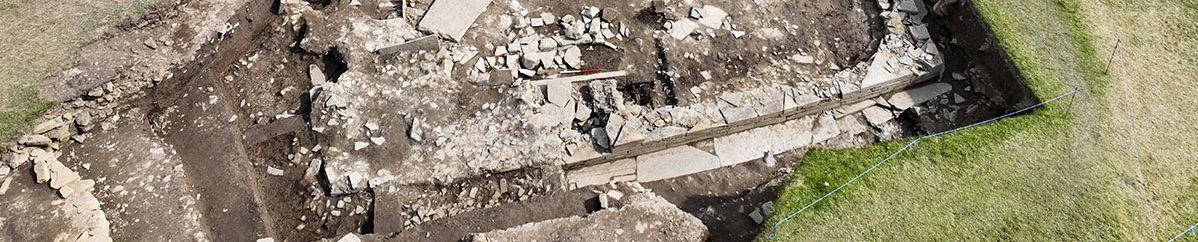
Central to Ritchie’s argument was what she described as the “best and most elaborate” example: the well at the Broch of Gurness (1995: 114). Constructing this chamber required the excavation of a substantial rock-cut pit measuring 5.5 m across and 4.5 m deep, into which was inserted “an elaborate drystone construction, very much in the broch architectural style” (Armit 2003: 108).
Such an undertaking must have pre-dated the construction of the broch itself, but by how long remains uncertain. Armit argued that the chamber was created either immediately before or during the broch’s construction, and therefore formed part of the site’s original design (ibid). More recently, however, Carruthers has suggested that it may have stood as an independent monument for a considerable period before being incorporated into the broch complex (forthcoming).
Further support for this interpretation comes from the discovery of Bronze Age pottery within the well at Crosskirk, Caithness (ibid). Comparable evidence is provided by the two Early Iron Age wells at Howe, Stromness, both of which predated the site’s later broch and originally existed as independent structures in their own right (Ballin Smith 1994: 28-29).
Whatever the timescale involved, the final result at Gurness was an elaborate underground chamber accessed through an entrance “hatch” set into the broch floor. From there, visitors embarked on what Armit described as a “precipitous descent” (2003: 108), following a flight of 18 stone steps down to a ledge overlooking a four-metre-high corbelled chamber. At the bottom lay a shallow pool of water (Armit 2003: 110), probably fed by a spring (Ritchie 1995: 113).
The complexity of the structure extended beyond the main chamber. Before reaching it, two smaller chambers could be accessed directly from the stairway. In addition, a concealed entrance, revealed only by removing steps from the stair, led to what Ritchie described as “secret sidechambers” (2003: 7). One of these was large enough, she suggested, to accommodate a standing individual (1995: 113).

“This is clearly more than a well,” Ritchie concluded (1995: 114), speculating whether the structure might have served as a prison or as a concealed space from which an “oracle” could speak, “heard but unseen” (ibid). By the time of the Minehowe excavations, however, she had largely abandoned the idea of incarceration in favour of the oracle hypothesis. Writing in 2003, she argued that “the stair and side chambers at Minehowe must surely also belong to the oracle type of structure, in addition to its function as a well” (2003: 7).
Minehowe also helped to reshape wider interpretations of broch wells. Writing in the same year, Armit agreed that their purpose must have extended beyond simple practicality. Echoing Ritchie’s earlier observations, he argued that the Gurness structure was an impractical means of obtaining water and resisted any “purely functional explanation” (2003: 110).
As Armit observed, “it seems highly unlikely that anyone would wish routinely to negotiate 18 steep, slippery steps whilst laden with buckets of water” (ibid). If access to water had been the sole objective, “[a] simple shaft, down which a bucket could be dropped, would have served the purpose just as well” (ibid).
The additional fact that the well could not have provided a sufficient water supply, led Armit to conclude that “[i]nstead, the importance… may lie in its ritual or religious significance” (ibid).
Before turning to Minehowe, it is worth considering the role of caves in prehistoric belief and practice. As natural subterranean features, caves served as repositories for human remains from the Mesolithic through to the Iron Age. Barnatt and Edmonds have argued that they were regarded as portals (2002: 113), places where people could “commemorate, commune with the spirits of the earth and seek revelation” (ibid: 125).
To Tilley and Bennett, caves were “places where the ancestral beings who created the world entered and left it” (2001: 344). Carruthers has also highlighted their continued use during the Iron Age and, in particular, their association with metalworking (forthcoming).
While caution is required when drawing upon isolated ethnographic parallels, an example from Papua New Guinea is nonetheless suggestive. There, sinkholes were regarded as passages to the underworld through which spirits could return “to haunt and to bless” (Tilley 1994: 60, quoting Poole 1986: 175). Returning to Britain, Parker Pearson noted an association between burials and sinkholes, proposing that “places in which water periodically appeared and disappeared may have been considered as entry points to the underworld” (1999: 132).

Whether natural caves, sinkholes or purpose-built subterranean chambers, such places appear repeatedly in prehistoric contexts – perhaps as points of contact between the human world and that which lay beyond.
It is the ability of supernatural entities to cross into the world of the living that may be central to the construction of Minehowe — the structure that undoubtedly led to a sea-change in the way broch wells, and their place in Iron Age society, were perceived.

A stone-built chamber excavated into a large glacial mound, Minehowe was first “investigated” in 1946 before being reopened in 1999. Excavations between 2000 and 2005 dated its construction and use to between 190BC and AD100 (Outram forthcoming) and confirmed that it formed the centrepiece of an extensive metalworking complex.
Like the “well” at Gurness, Minehowe was entered by a dramatic, choreographed, descent into the earth. From an opening at the summit of the four-metre-high mound, a staircase of 29 stone steps spiralled anticlockwise down to the subterranean chamber below.
The initial flight of steps carried visitors 2.5 metres down in a south-south-easterly direction to a narrow landing. From here, two long, low chambers extended away at almost right angles.
A second staircase then reversed direction, leading north-north-west and deeper into the mound. The descent ended abruptly with a 90cm drop into the lower, D-shaped chamber at the base of the structure (Card & Downes 2003: 13).

Approximately six metres below the summit of the enclosing mound, the lower chamber was a small, confined space capped by a finely corbelled roof rising to a height of four metres.
Following a familiar pattern, the 1946 excavators interpreted the structure as a well. Yet the material recovered from within was far from what might be expected of a simple water source. According to contemporary reports, excavators uncovered “stone axes, knives, hammers and a piece of clay urn”, alongside “hundreds of bones and other relics”, “curious polished stones”, cockle shells and two human teeth (The Orcadian 1946).
All of these artefacts were removed during the 1946 investigation and their archaeological context lost. When excavations resumed in 1999, all that remained were two stone pounders, a dog skull and pottery fragments dating from the second century BC onwards (Card & Downes 2003: 16).
Minehowe’s architectural affinity with broch sites was noted from the outset. In 1946, James Richardson, of the Inspectorate of Ancient Monuments, in Edinburgh, was convinced that the site represented the remains of a broch (The Orcadian 1946). The 21st century excavations demonstrated that this interpretation was incorrect, but the mistake itself is not surprising. As Card and Downes pointed out, “although Minehowe is certainly not part of a broch, the nature and characteristics of both the chamber and ditch are very ‘broch-like'” (2003: 16).
Like the supposed defensive examples around brochs, Minehowe was encircled by a substantial ditch measuring seven metres wide and four metres deep. Access to the mound and its subterranean chamber was controlled by a single causeway on the north-west side (Card & Downes 2003: 13).
The ditch itself underwent several phases of remodelling and infilling, indicating a prolonged and complex history of use (ibid). Significantly, pottery recovered from its lower fills closely resembled material found within the chamber, suggesting that Minehowe was contemporary with the Orcadian broch tradition (ibid: 16).
Although the ditches surrounding brochs were traditionally interpreted as defensive features, much like the brochs themselves (Ritchie 1995: 101, 109; Armit 2003: 113), such an explanation is difficult to sustain at Minehowe. The notion of a defensive ditch encircling a subterranean chamber is, at best, implausible. Yet the scale of the excavation, together with the subsequent remodelling of the earthwork, demonstrates that it was a significant, perhaps even essential, component of the monument.
For Card and Downes, the ditch acted as “a boundary around the underground structure”, while the narrow causeway “served to direct the approach to, and restrict access to, the chamber” (2003: 13). Its size, together with later embellishments, further “emphasised the monumentality and significance of the site” (ibid).
But the ditch did more than exclude the ordinary world. As Darvill suggested of the ditch-and-bank arrangements surrounding Neolithic henges, these earthworks may have been intended to “keep things in, rather than out” (1987: 80). If Minehowe was conceived as a point of contact between the worlds of the living and the supernatural, the earthwork may have served not simply to define a sacred space, but to contain the forces associated with it.

But contain what? Metalworking, and the “magical” practices surrounding it, seems like a likely candidate.
The evidence from Minehowe suggests it was no ordinary settlement. An iron-smelting furnace stood on the mound itself, while signs of intensive copper- and iron-working were found across the site. Equally significant is the apparent absence of domestic activity, indicating that Minehowe served a specialised purpose rather than functioning as an everyday settlement (Friends of Orkney Archaeological Trust 2005: 10-11).
This interpretation gains further support from the discovery of two inhumations at Minehowe, including one placed beneath the floor of the smithy building. Combined with the evidence for intensive metalworking, these burials point to the “symbolic significance” of the metallurgical process (Card et al. 2005: 327).

The transformation of ore into metal is more than a technical achievement. Ethnographic studies suggest it is frequently perceived as a dangerous and powerful act, transforming “shiny metal from rough rock” (Aldhouse-Green 2005: 131). According to Andren (2005) and Jorgensen (2012), prehistoric metalworking was similarly enveloped in myth and magic. Within this worldview, the smith was a liminal figure: far more than a skilled artisan, but a “multifaceted figure with many roles and functions beside that of working iron” (Jorgensen 2012: 2), whose abilities were both “desired and feared” (Andren 2005: 121).

Metalworkers were “boundary crossers”, controlling fire, “the ultimate transformation agent” (Aldhouse-Green 2005: 131). Their craft involved the transformation of one substance into another and, according to Giles, engagement with forces perceived as supernatural (2007: 405).
As a result, metallurgical knowledge was viewed as both productive and potentially dangerous, possessing the power to regenerate as well as destroy (ibid: 409). Such ambiguity helps explain why metalworking frequently took place in liminal spaces beyond the everyday sphere of settlement (Hingley 1997).
The otherworldly power attributed to smiths placed them in what Aldhouse-Green described as a “paradox” (2005: 132). Living on the margins of ordinary society, they nevertheless occupied a central position within it and remained dependent upon the wider community (ibid; Card & Downes 2003: 17-18).
While it has been suggested that such separation may have been imposed upon metalworkers by others (Carruthers, in prep.; Card & Downes 2003: 17-18; Aldhouse-Green 2005: 132), the layout of the Minehowe complex hints at something more deliberate.
Rather than being simply excluded from society, its occupants appear to have consciously marked themselves as distinct through the inversion of elements commonly associated with ordinary settlement layouts. The entrance causeway, for example, faces north-west, rather than the east- or south-east-facing (i.e. towards sunrise) alignment commonly found in English roundhouses (Parker Pearson et al. 1996: 61; Parker Pearson 1999a: 43).
This orientation should not, however, be interpreted as a straightforward reversal. Nearly half of Scotland’s brochs also face westward (Parker Pearson 1999: 44-45). While Parker Pearson initially associated this orientation with death and the night, he later revised the interpretation, suggesting instead that it emphasised social distinction and perhaps marked the residences of “local elites or other segregated groups” (ibid).
So while Minehowe’s arrangement might initially appear to invert that of sites such as the Broch of Gurness, it in fact mirrors the layout of Midhowe broch. Perhaps, as Parker Pearson argued, Midhowe’s inhabitants also sought to differentiate themselves from the wider community (ibid).
Where Minehowe genuinely inverts expectations is in the treatment of its chamber. Across Atlantic Scotland, access to the underworld typically required a descent into the earth. At Minehowe, however, the subterranean realm was effectively raised upwards. Set within a prominent mound, the chamber was removed from its usual subterranean setting and elevated above the surrounding landscape.

The result was a reversal of the traditional vertical axis: the world below was brought closer to the world above, and what was normally concealed was made visible. The significance of this cosmological principle, and of its deliberate inversion, may ultimately have its origins in the Bronze Age.
Such a deliberate reordering of cosmological space may seem unusual in an Iron Age context. Yet evidence from Orcadian Bronze Age funerary monuments suggests that similar manipulations of the relationship between upper and lower “realms” may have much deeper roots.
Investigating Orcadian barrow cemeteries, Downes observed that barrows were created from material taken from the cremation pyre and reconstituted in reverse order (Downes & Thomas 2013: 79). Such a process effectively inverted the relationship between upper and lower realms within a cosmological scheme consisting of an upper world (the sky, daylight and the sacred), a middle world of the living, and a lower world associated with water, darkness and the night (ibid: 76).
For Downes and Thomas, “this vertical, tripartite ranking of the universe is likely to have been quite widespread both in space and time” (ibid). The idea finds an intriguing parallel in Parker Pearson’s “symbolic geography” of Iron Age Denmark (1999b: 70). There, the upper realm was reserved for the “worthy dead”, transformed through cremation and associated with the transformative power of fire. The middle realm belonged to the living, while the lower realm comprised a wet underworld inhabited by the “entirely untransformed” sacrificial and executed dead (ibid).


While Minehowe’s spatial layout could be viewed as the inverse of a broch, the inversion of the vertical axis ultimately brings the two together as opposite expressions of the same underlying cosmology. As Parker Pearson observed, the dead reside “as ancestors, gods or spirits in a world which is often the inverse of life on earth” (1999b: 204).
If we approach the underworld in this way, and consider inversion as a form of reflective symmetry (cf. Pryor 2002: 275-279), then a broch viewed from the underworld becomes a “well”, while a ditch becomes a bank or rampart, and vice versa.
Rather than representing fundamentally different forms of architecture, brochs and wells can be seen as mirror images of one another, each occupying a position through which the living, the dead and otherworldly beings could “negotiate and mediate with one another” (Davies & Robb 2004: 146).
The extraordinary effort and resources devoted to constructing Iron Age monuments that reached both skyward and deep into the earth imply an increasing concern with mediating between different realms. Those who possessed the authority to access, control or manipulate this axis may consequently have occupied positions of exceptional status within society.
Minehowe’s inversion may have carried profound significance. Was the monument intended to demonstrate control over the underworld by raising it into the sphere of the living? Yet if contact between worlds was the objective, why isolate Minehowe behind its ditch and causeway when similar chambers were integrated within thriving broch settlements?
The answer may lie in the broch itself. These massive, double-skinned structures may have been more than monumental residences. They may also have functioned as architectural containers, bringing together the upper, middle and lower realms while carefully regulating contact between them. Viewed in this way, the broch and the subterranean chamber were not opposites but complementary mechanisms for mediating between worlds.
The act of moving between those worlds was equally important. Whether ascending within a broch or descending into a well, traversing the vertical axis required movement around the horizontal one. Climbing upwards involved a sunwise, clockwise, progression, while descent demanded movement against the course of the sun. That such distinctions retained significance in Orkney into the 20th century, when anticlockwise movement was regarded as inauspicious and contrary to the natural order (cf. Marwick 1991: 34), suggests that direction itself may have carried symbolic weight.
Minehowe stands out as a monument that deliberately challenged the natural order. Through the inversion of its architecture, the anticlockwise descent into the underworld was no longer concealed beneath a broch but raised into plain view. The monument transformed what was normally hidden into a public spectacle. Set within a natural amphitheatre and encircled by boggy marshland, it created a stage upon which metalworkers could perform elements of their craft before an audience.
Many questions surrounding Minehowe remain unanswered, but its purpose as a deliberate visual statement seems difficult to deny. Through its architecture, setting and relationship to the surrounding landscape, the monument distinguished both itself and its community from the norms of Iron Age society. The available evidence suggests that this identity was rooted in metalworking and in the special status afforded to those who practised it.
To understand Minehowe, therefore, we must move beyond viewing metallurgy as a purely industrial process. For Iron Age communities, the transformation of stone into metal may have represented access to powers beyond the human realm. If so, the smith’s elevated position derived not simply from technical skill but from an ability to mediate between worlds. Minehowe gave architectural expression to that claim. Through inversion, it brought the hidden into view, the underworld closer to the living, and the power of its inhabitants into public display.
Perhaps just as important, however, is the recognition that while Minehowe appears to be the polar opposite of the Orcadian broch, the two may be inseparable within a tripartite cosmological framework. Viewed in this way, broch and well are not competing forms of architecture but complementary expressions of the same underlying beliefs. Neither can properly be understood without the other.
Such a perspective also helps free the broch from the centuries-old constraints of purely functional interpretation. Rather than simply a defensive tower, status symbol or monumental dwelling, the broch may have been conceived as a structure that linked and mediated between different realms of existence. Like Minehowe, it can be understood as a monument that spanned the worlds of the living and the dead.
Notes
- Aldhouse-Green, M. & S. (2005) The Quest for the Shaman. London: Thames & Hudson.
- Andren, A. (2005) Behind Heathendom: Archaeological Studies of Old Norse Religion. Scottish Archaeological Journal. 27 (2), 105-138.
- Armit, I. (2003) Towers in the North: The Brochs of Scotland. Gloucestershire: Tempus Publishing Ltd.
- Ballin Smith, B. (1994) Howe: four millennia of Orkney prehistory excavations, 1978-1982. Society of Antiquaries of Scotland.
- —. (2005) Orcadian Brochs: Complex settlements with complex origins. In Turner, V. E., Dockrill, S. J., Nicholson, R. A. and Bond, J. (eds) 2005. Tall Stories: Two Millennia of Brochs. pp 66-77. Shetland Amenity Trust, Lerwick.
- Barnatt, J. & Edmonds, M. (2002) Places apart: caves and monuments in Neolithic and earlier Bronze Age Britain. Cambridge Archaeological Journal, 12(1), pp. 113–129.
- Callander, J.G. and Grant, W.G. (1933) The Broch of Midhowe, Rousay, Orkney. Proceedings of the Society of Antiquarians of Scotland. 1933. Vol 68. pp 444-516.
- Card, N., Downes, J., Gibson, J. and Sharman, P. (2005) Religion and Metal Working at Mine Howe, Orkney. Current Archaeology 199, 322-327.
- Card, N. and Downes, J. (2003) Minehowe – The significance of space and place in the Iron Age. In Downes, J. and Ritchie, A. (eds) Sea Change: Orkney and Northern Europe in the Later Iron Age AD300-800. Pinkfoot Press, Angus.
- Darvill, T. (1987) Prehistoric Britain. Routledge.
- Davies, P. & Robb, J. G. (2004) Scratches in the earth: the underworld as a theme in British prehistory, with particular reference to the Neolithic and earlier Bronze Age. Landscape Research, 29:2, 141-151.
- De Bello Gallico. (1980) Wiseman & Wiseman.
- Downes, J. and Thomas, A. (2013) Where Mythical Space Lies: Land Ownership versus Land Use in the Northern Bronze Age. In An Archaeology of Land Ownership (pp. 70-92). Routledge.
- Fitzpatrick, A.P. (1996) Night and day: the symbolism of astral signs on later Iron Age anthropomorphic short swords. Proceedings of the Prehistoric Society 62, 373–98.
- Giles, M. (2007) Making metal and forging relations: ironworking in the British Iron Age. Oxford Journal of Archaeology, 26 (4), pp.395-413.
- Hingley, R. (1997) Iron, ironworking and regeneration: a study of the symbolic meaning of metalworking in Iron Age Britain. In Gwilt, A. & Haselgrove, C. (eds). Reconstucting Iron Age Societies. Oxbow Monograph, pp 9-18.
- Jorgensen, R. (2012) The Social and Material Context of the Iron Age Blacksmith in North Norway. Acta Borealia. 29 (1), 1-34.
- Mackie, E. (2002) The Roundhouses, Brochs and Wheelhouses of Atlantic Scotland c700BC-AD500. Oxford: Archaeopress.
- MacGregor, A. (1974) The Broch of Burrian, North Ronaldsay, Orkney. Proceedings of the Society of Antiquarians of Scotland. 1974. Vol 105. pp 63-118.
- Marwick, E. W. (1991) An Orkney Anthology. Edinburgh: Scottish Academic Press.
- Parker Pearson, M. (1999a) Food, Sex and Death: Cosmologies in the British Iron Age with particular reference to East Yorkshire. Cambridge Archaeological Journal 9:1. pp 43-69.
- —. (1999b) The archaeology of death and burial. Stroud: Sutton Publishing.
- Parker Pearson, M., Sharples, N. and Mulville, J. (1996) Brochs and Iron Age society: a reappraisal. Antiquity, 70: 57–68.
- Pearce, M. (2013) The Spirit of the Sword and Spear. Cambridge Archaeological Journal, 23, pp 55-67.
- Petrie, G. (1890) Notice of the brochs or large round towers of Orkney. Archaeologia Scotica, 5, pp 71-94.
- Pryor, F. (2002) Seahenge: A quest for life and death in Bronze Age Britain. London: HarperCollins.
- Ritchie, A. (1995) Prehistoric Orkney. London: Batsford Ltd.
- —. (2003) Paganism among the Picts and the conversion of Orkney. In Downes, J. and Ritchie, A. (eds) Sea Change: Orkney and Northern Europe in the Later Iron Age AD300-800. Pinkfoot Press, Angus.
- The Friends of the Orkney Archaeological Trust. (2005). Mine Howe: fieldwork and excavation 2000-2005. Kirkwall: Occasional Publication 1.
- The Orcadian. (August 29, 1946). Kirkwall: The Orcadian Ltd.
- Tilley, C. (1994) A Phenomenology of Landscape. Oxford: Berg.
- Tilley, C. & Bennett, W. (2001) An archaeology of supernatural places: the case of West Penwith. Journal of the Royal Anthropological Institute, 7, pp. 335–362.
- Warner, R. B. (2000) Keeping out the otherworld: the internal ditch at Navan and other Iron Age ‘hengiform’ enclosures. Emania 18, 39–44.


