
Dig diary – a planning marathon, orthostats, clay and Grooved Ware

Day Seven
Tuesday, July 14, 2026
Patient and meticulous excavation reaps rewards and today saw a series of mini revelations that are beginning to shed some light on what is going on in Trench TT.
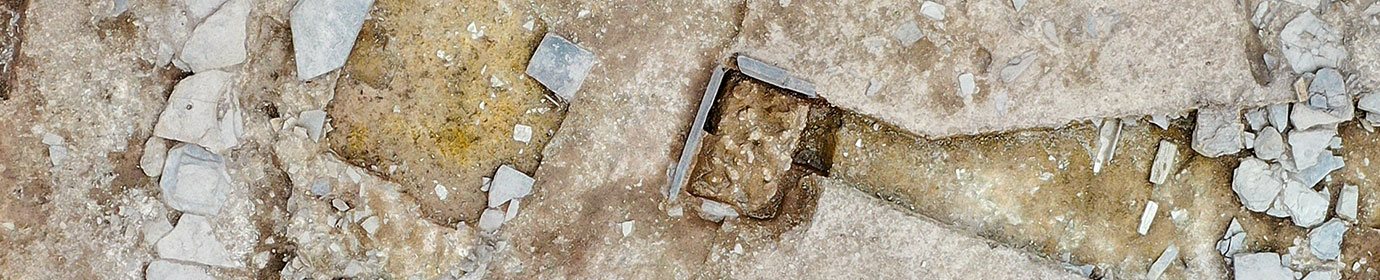
Work to remove overlying material from the south-eastern quadrant continued, revealing more of the circular anomaly’s stonework as well as some apparently substantial structural rubble alongside.

Of particular interest, is what appears to be an orthostatic arrangement that projects inwards, at a right angle, from the interior wall. Yesterday, you’ll recall we had found three orthostats that seemed to also seem to relate to the circular feature (which Paul says he’s happy now to refer to as a structure) but these were placed parallel to the inner wall.
The projecting masonry, which brings to mind the piers found in the Ness buildings around 3200BC onwards, will be excavated further when the quadrant is brought down to the same level as its neighbours.


Revealing the structural rubble in the south-eastern quadrant. (📷 Sigurd Towrie)
In the south-west quadrant, two sections were inserted to try and make sense of the fairly extensive rubble spreads. One is perpendicular the the circular feature, the other running eastwards from the trench’s south-western corner.
In the former, Sigurd came across a fairly thick layer of a yellowy clay material running out from the circular structure’s wall and into the rubble alongside.

We’ve seen this before – yellow clay was used for the floors in the monumental buildings lying to the south-east. It was also a feature in other monumental buildings, e.g. Maeshowe, which were built on a platform of yellow clay. Naturally, this needs further excavation but at present it seems that the clay runs over the surviving masonry of the circular structure, which points to it (or at least part of it) being deliberately covered over.
Because the ard marks, a short distance away, are in this yellowy material suggests they (that group at least) post-date our circular, mystery structure.
Meanwhile, by close of play, Ray had revealed some more substantial, flat stones in his corner of the south-western quadrant. Again, time will tell whether they relate to something structural or just more discarded material. The fact they are almost perfectly horizontal suggests the former.


One of our ceramics specialists, Jan Blatchford, was delighted today to finally find some pottery! Working in the south-eastern quadrant, she found very small fragments of what she instantly recognised as a cordon-decorated Grooved Ware pot – albeit one that pales in comparison to some of the stunning examples found over the past 20 years.
The style of Neolithic pottery emerged around 3200BC. This, the lack of other pottery in the area, and our potentially Early Neolithic leaf arrowhead does hint at artefacts being brought in with the material used to cover the site.


Plan Jim. Plan! (📷 Sigurd Towrie)

Nobody can deny that a well-executed archaeological plan is a thing of beauty. That said I doubt you’d find many folk rushing to volunteer to plan! Thankfully for us, Jim Rylatt (former supervisor of Structure Twelve) did exactly that and set to the back-breaking work of planning the north-eastern quadrant.
This selfless act of archaeological stamina saw him bent double over a planning frame and board for seven(ish) hours. The result was a masterclass in the art of planning.
Determined to get it finished to excavation can resume in the quadrant, Jim was still drawing away after most of his trench colleagues had headed home for the day! But I’m sure you’ll agree it was worth it.
Glancing up from the trenches today it was clear that the visitor numbers were up. An impression confirmed after the head-count was tallied up when the site gate closed.
A grand total of 311 people made their way to the Ness today, along with a group of 17 local artists who were taking part in the first day of our three-day Heritage Lottery Funded workshop on site.


