
Dig diary – gneiss, soil and a shadow of something taking shape

Day Ten
Friday, July 17, 2026
As we reached the final hours of week two, something began to emerge in the centre of the trench. Exactly what it is will have to wait for more excavation on Monday! So watch this space.
Across the trench, careful trowelling and mattocking continued, and one find in particular echoed some of the spectacular artefacts uncovered at the main Ness complex a few hundred yards to the south‑east. While mattocking in the north‑western quadrant, Tom revealed a fragment of partially worked and polished Lewisian gneiss.

This distinctive rock, sourced from the north‑west coast of Scotland and the Western Isles, has long testified to Neolithic links between those regions and Orkney. Several of our polished stone artefacts – especially maceheads – were crafted from it. Today’s fragment, however, had taken quite a beating. Although unmistakably gneiss, whatever form it was meant to take never reached completion.
Like other finds so far, the gneiss fragment’s location, in the disturbed top soil of the quadrant, is due to redeposition/disturbance so is not diagnostic.


Meanwhile, recording of the growing number of ard marks continued today, with Jan sampling the shallow grooves for environmental analysis and Lucy had a planning frame out.


Ard marks in the north-eastern quadrant. (📷 Sigurd Towrie)
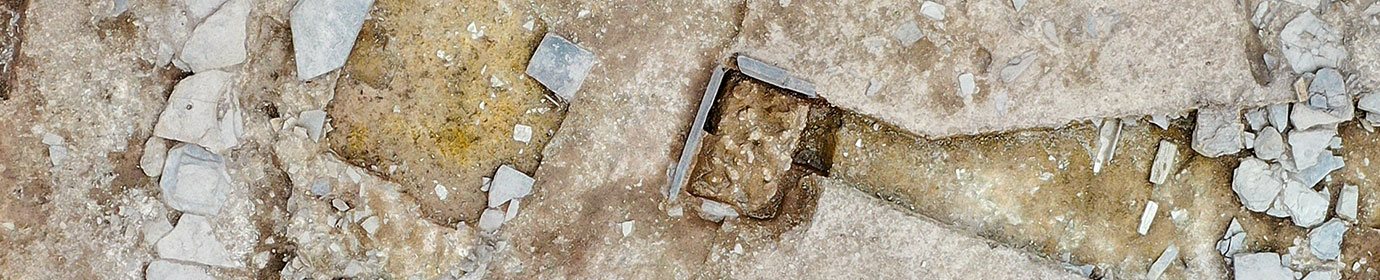
Over in the south-eastern quadrant a sharply defined square of dark material stood out from the yellow material surrounding it. Given the location of nearby fence lines, there was little doubt that this was a modern(ish) fence-post socket.


Going down under. Paul sets to work on the fence post socket. (📷 Sigurd Towrie)
So Paul set to work, catching the attention of many site visitors as he dug deeper and deeper. As well as confirming the fence-post hypothesis, he also clarified the stratigraphy of the trench. The sides of his small, but deep, sondage showed these three layers perfectly and highlighted, yet again, the shallow depth of the archaeology.
The natural lay less than 70cm beneath the current ground surface. Immediately above it was a 10cm thick layer of midden material before the rubble-filled, yellow layer of redeposited natural.

Hopefully that will explain why Paul had his head down a deep hole!
With that, I’ll call it a night – but before I go, a reminder that Time Team’s Ness of Brodgar special goes live on YouTube tomorrow evening at 7pm.
Until Monday…


