
From the archive: Evidence of Neolithic village confirmed at Ness of Brodgar

We’re jumping back almost 22 years today, with the discovery of a newpaper clipping from June 17, 2004 – the first time the extent of the discovery on the Ness of Brodgar was reported in print.
At the time, Sigurd was a reporter at The Orcadian and rushed back to the newsroom to make sure the work made it into that week’s paper. We’ve reproduced the text below for posterity. A quick read through really highlights that, even in those early days, Nick had really hit the nail on the head regarding the nature of the underlying archaeology.

Centuries-old conceptions about the Ness of Brodgar – the thin strip of land between the Harray and Stenness lochs – look set to be turned on their heads following a series of exploratory excavations.
Last year’s discovery of a structure half-way between the Ring of Brodgar and the Standing Stones of Stenness gave the first hint that ideas were going to have to change.
A “domestic settlement” in an area thought to be solely the domain of ritualistic and funerary monuments was a clear sign that certain long-held notions about the Brodgar peninsula needed to be looked at again.
The structure’s discovery, together with a series of extensive geophysics scans of the World Heritage Site area, were beginning to indicate the sheer extent of prehistoric human activity on the Ness of Brodgar – and perhaps, most intriguingly, that this activity wasn’t entirely based around the stone circles.
But even the geophysics results couldn’t prepare the archaeologists for what they found after metre-square test pits were dug around the site of the “Brodgar New Hoose” – in particular that the area around Lochview could still house an extremely well-preserved Neolithic “village”.
A team of four archaeologists led by Nick Card, projects manager of the Orkney Archaeology Trust has spent two weeks on site and uncovered tantalising evidence of a massive “village” that once stood between the two stone circles – a settlement with an area of approximately 2.5 hectares that appears to have been used throughout the Neolithic period (approximately 3500-2400 BC).
Nick explained: “We knew this area was covered in magnetic anomalies from the surveys that were carried out previously, so for this project we deliberately chose to put down trenches that would avoid the major items of archaeology indicated by the geophysics.
“But even in these ‘quiet’ areas we’ve been astounded as every one of the five trenches has produced archaeological remains. We really are at the heart of Neolithic Orkney here.”


2004: Ness of Brodgar test pits. (📷 Sigurd Towrie)
What has become clearly apparent is the way the landscape was altered by these Neolithic farmers. The trenches revealed massive quantities of deliberately “improved” soil over the area of the settlement – soil enriched by the addition of midden material to a maximum depth of 2.5 metres.
This human alteration to the landscape has resulted in a massive man-made mound on which the current house, Lochview, now stands. Standing on this field-spanning mound, the profile of the Ring of Brodgar and its surrounding howes juts starkly on the horizon to the north-west.
At the bottom of a deep trench, on what would appear to be the periphery of the settlement, were what appeared to· be the lower courses of an early Neolithic structure. A short distance.away, a few centimetres beneath the top soil and higher up the mound, lies the late Neolithic structure discovered by Beverly Ballin-Smith last year.
This confirms that as time passed, and as earlier structures fell out of use, new buildings were erected on top – a process that led to the gradual formation of the current settlement mound. But even looking at the remains of the oldest building, Nick suspected there were still earlier levels underneath.
“We think there’s even earlier phases under this, so what we’re looking at is a constant change in the height of the mound with the result that the landscape was being altered throughout the life of the settlement.”
Almost guiltily referring to that oft-used phrase “scratch Orkney’s soil and it bleeds archaeology” Nick admitted that on this site it couldn’t be truer.
“What we have come to realise is that we’re looking at a landscape dotted with more archaeological remains and sites than even the geophysics scans have picked up,” he said.
Towards the western outskirts of the settlement, and overlooking the water of the Stenness loch, is a large geophysics anomaly that may be a chambered cairn. Although it will take a full excavation to confirm whether this is the case, if it turns out to be so – and is contemporary with the settlement – it provides another interesting challenge to current thinking on the role and positioning of these “houses of the dead”.
So far, these tombs have generally been found outside areas of domestic settlement, in locations that led to the idea that they were deliberately kept away from, and distinct from, everyday life. If the anomaly at Lochview proves to be a tomb, the archaeologists will have to look at this idea again and it may provide some clues as to the structures’ roles other than simple repositories for the Neolithic dead.
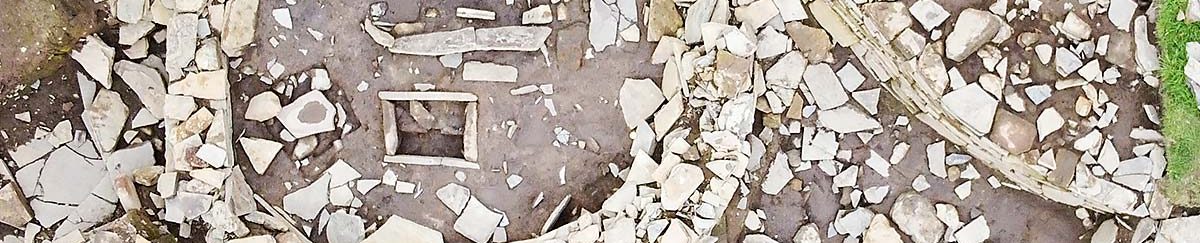
Moving to the north-west, and closer to Brodgar farmhouse, another trench contained a rectangular stone setting that looked remarkably like a burial cist. The mystery deepened, however, when it was found to contain no human remains. Although the brief glimpse of the structure was intriguing, it will have to remain a mystery until further excavation can confirm whether it is an isolated feature or part of a larger building, the purpose of which is unclear. [note: with the benefit of hindsight and subsequent discoveries, this feature was probably a small, denuded hearth].
One of the most striking features on the geophysics results was a huge rectangular anomaly that roughly follows the modem road for approximately ten metres before bending westward at a sharp 90-degree angle.The scale of this “wall” led to its interpretation as a medieval construction, so a trench was put down to explore it further. This showed extensive stretches of stonework, with what appeared to be a large paved area towards the centre of the settlement.
Nick explained: “All we can say for sure about this is that we now know it is definitely not medieval. All the finds have been prehistoric. It’s really impossible to say for certain from what we’ve seen so far but it seems to be a new class of Neolithic monument, for Orkney at least.”
He added: “It could be something to define the boundaries of the settlement area, or perhaps in some way be related to the cursus monuments (elongated rectilinear earthwork enclosures) found in the south. To make any sense of it is going to require a much bigger trench and as to what it is and was used for awaits a full excavation.”
With the dig drawing to a close, Nick pointed out some of the other areas of the site that their investigations had not even touched – including the site of a large stone structure similar to Structure Eight at the nearby Barnhouse settlement, and a large mound by the road that might even house broch remains.
Summarising, he said: “We’ve managed to fulfil all our main objectives and shed a little more light on this section of the World Heritage Site. But, as usual, we’re left with more questions than answers. This has simply been a quick look at the site and we can’t fully understand a lot of what we’ve found, but it shows the potential of this area for future work.
“What has become clear is that a full excavation would be dealing with very well preserved Neolithic structures. Compared to the Barnhouse settlement, which was very badly degraded when excavated, the buildings here have perhaps survived to up to half a metre in height.
“There is no doubt at all that further work on this site will help us further understand the Neolithic in Orkney, in particular the Ness of Brodgar’ s role in the daily life, rituals and beliefs of the Neolithic inhabitants of the county.”
The excavation was funded by Orkney Islands Council, and supported by Historic Scotland. Orkney Archaeological Trust would also like to thank Mr and Mrs Hoey, Lochview, Stenness, and Ola and Amie Tait, Brodgar, Stenness.


