
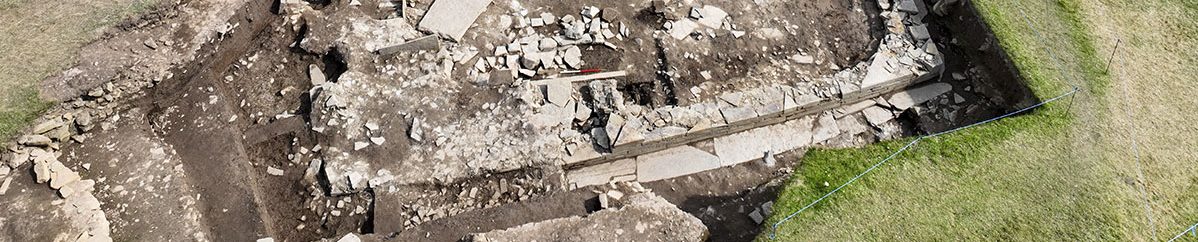
‘Rocks with a story to tell’ – analysing wall composition of Ness structures

By Dr Martha Johnon
Over the last 16 years, I’ve become more and more immersed in the rocks at the Ness of Brodgar.
From the beginning, the area covered by the site and the size of the structures being excavated – the sheer monumentality of the Ness – overwhelmed my senses. It was all too big to comprehend. Viewed from the edge of the trenches, the archaeology in front of me was so vast I did not really see the details. I was taking photos from the same places each excavation season, trying, and not really succeeding, to get a handle on the individual component parts of each structure, the walls, the rocks.
As part of my Ness of Brodgar PhD research, Mark Edmonds had the idea that I not only assess and identify the “loose” Ness rock being recovered, but that I also assess and identify the rock in the drystone walling of the Ness structures. This was not straightforward given my mobility difficulties (and there were some hairy moments) but with the scanning ingenuity of Mark Littlewood and the physical support of Mark and Gary Lloyd, we have created a record of the walls for just about all of the Ness’s structures.
I developed a protocol to identify the various rocks in the walling employing the possible combinations of 1) texture, 2) composition and 3) bedding thickness of sedimentary rock. Each wall member/rock/block in an assessed wall segment was identified and the various rock components quantified.

Employing that protocol for the first time in 2016 completely changed my perspective of the Ness of Brodgar! It changed from the broad macro of acres, whole structures and walls to the micro of small parcels of detail and individual rocks. The walls I had admired from a distance changed dramatically when I was only a metre away.
They were constructed of different rocks; mudstones, mud-siltstones, siltstones and sandstones and they were not all tan-coloured.
I could think through the detail. While most wall rocks were as fresh as the day they were set in crisp, tight, wall lines, some of the component wall pieces were delaminating, some were fractured, and some had almost disintegrated (one of the reasons the site had to be infilled again).
All the bedrock of the Stenness-Brodgar peninsula is horizontally bedded sedimentary rock, easily pry-quarried, and is rock from which e.g. Structures One, Eight and Fourteen are built. No mason building walls the quality of those at the Ness would select and use inferior rock.
The walls, which today comprise fractured and delaminated wall members, would have looked as good as any other wall at the Ness when they were built 5,000 years ago. What this showed me was that various quarries had been used by the Ness’ Neolithic stonemasons: without knowing that some of these quarries were of lesser quality than others and that rock would, in time, fracture and delaminate, whilst other rock held tight, just as they were first built.
The assessment also highlighted for me that some walls had the thickest rock members placed at the base of the wall; others had the thickest at mid-wall height. The size of wall members varied from structure to structure. Each structure had a different proportion of the various sedimentary rock in the interior and exterior walls. There was much variation and that variation was the result of different structural plans, different quarries, different masons with different preferences for wall rock and for wall construction.
This was no standardised complex; this was individuality being exercised wall by wall by those creating their buildings at the Ness.

Structures Ten and Twelve introduce beautifully big, knock-out, peck-dressed and plain blocks of sandstone to the internal architecture.
It has given me great pleasure to detail the minutiae of these glorious rocks, discerning different sources, considering the care with which they were selected, quarried and transported from much further than the Brodgar isthmus – places such as Houton, in the adjacent parish of Orphir, and along the north coast of the Mainland to Scapa.
The walls have become statements in themselves, about prestige and monumentality and those who can command such places.
And then there is Structure Twenty-Seven, in Trench T.
To me, the remaining walls of Structure Twenty-Seven are a constant source of amazement and astonishment. On display here is a level of quarrying knowledge and skill, masonry technique and architectural confidence unmatched in Neolithic Orkney, excepting perhaps Maeshowe.
The masons constructing the fine exterior walls of Structure Ten skillfully used a variety of siltstones, silt-sandstones and sandstones and a variety of wall members sizes, both in length and height. Impressive enough to study close -up. Those constructing the exterior walls of Structure Twenty-Seven, however, used only one variety of mud-siltstone. The wall members are identical and appear to have come from one source. The blocks are of a uniform thickness within one course, i.e. one course having members 7 to 9 cm in height and the courses above and below having members 13 to 15 cm in height.
The rock choices and masonry techniques used in Structure Twenty-Seven produced walling more uniform and beautiful than any other building at the Ness of Brodgar.
It has brought joy to the heart of a geologist who initially baulked at the detailed study of the Ness’s walls, wondering what she could say and learn from them.
But those rocks have a story to tell of which much, much more detail to come – you just have to get up close and personal to learn what the right questions are to ask.


