
Focus on finds: Skaill knives (and how to make them)
in the parish of Sandwick, Orkney, recently excavated (1867)

Not all the stone tools from the Ness of Brodgar are works of exquisite craftsmanship that took patience and skill to fashion. Some are obviously purely functional – none more so than “Skaill knives”.
These are simple, handheld stone “blades” created by striking a flake from a large, rounded, sandstone cobble.
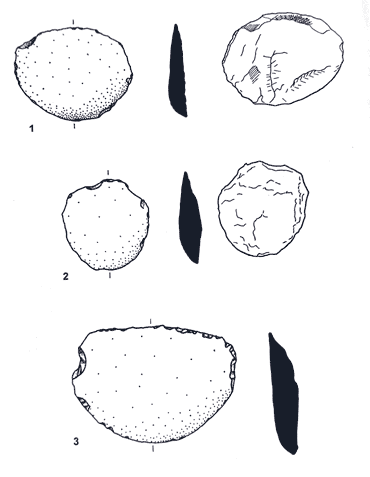
During excavations at Skara Brae in the late 1920s, Gordon Childe found these flakes in such quantities that he named them Skaill knives.
Why?
Because Skara Brae sits on the southern shore of the Bay of Skaill.
The process to create a Skaill knife is very simple.
Throw a suitable beach cobble against another secure stone (but stand back – they can bounce!). The resulting flake has a sharp edge, providing a cutting tool that experimental work has shown to be highly efficient at butchery [1].
It was the Orcadian antiquarian George Petrie who recognised Skaill knives for what they were. In 1867, almost 20 years after Skara Brae was exposed by the elements, Petrie wrote: “There is one type of stone implement very abundant at Skaill.” [2]
These flakes had been:
Petrie added:

Although certain the flakes were not the result of natural attrition, Petrie was perplexed. “The process by which these rude stone implements had been obtained seemed to be still a matter of doubt,” he declared.
To him the answer came on a visit to Westray, where Petrie witnessed his son hurling beach stones on the rocks. The boy, he realised, had “unwittingly rediscovered the ancient mode of producing the rude stone implements”.
Petrie had been investigating a “kitchen midden” within some “artificial mounds”. Excavating with a pocket-knife, he and a colleague found “great numbers of stone flakes similar to those from Skara”. [2]
The artefacts were clearly on his mind when he later encountered a stone on the beach. It had clearly been broken a few hours earlier, but by natural causes.
Watching the results of his son’s stone-breaking exploits, Petrie had a go himself:
While Petrie was correct in some respects, my own personal experiments (far from scientific) have confirmed that hurling beach cobbles at rocks is not a very practical way to create Skaill knives. The success rate was very low, perhaps about one in 30 – not a very efficient, nor reliable, way to produce large quantities of the stone tool.
Petrie’s theory is further questioned in a study of the Skaill knives from the Ness of Brodgar, published in The Journal of Lithic Studies.
This noted consistent impact points in the centre of the thinnest side of the cobble where it had been struck:
Instead, based on the evidence the authors propose that the Ness Skaill knives were created by deliberately, and carefully, striking specific points of the parent stone to split it. [3]
The nature of their fabrication means that Skaill knives can vary in size, with their shape dictated by that of the parent cobble.

Few excavated examples show evidence of reworking – it seems they were used until the sharp edge dulled, or was damaged, and then thrown away.

As mentioned previously, it seems likely that Skaill knives primary role related to butchery. Evidence gathered by lithics specialist Ann Clarke has shown that, for this purpose, they were extremely efficient:
Further Reading
- Skaill knives – Working Stone.
- Stone tools and Butchering by Ann Clarke, Lithic Specialist
- The Skaill Knife as a butchering tool, by Ann Clarke (PDF)
- A decorated Skaill knife from Skara Brae, Orkney, by Alan Saville (PDF)
- Skaill knives from the Ness of Brodgar: an experimental pilot study exploring their potential for functional- and technological analysis.
Notes
- [1] Clarke, A. (2006) Stone tools and the Prehistory of the Northern Isles (Vol. 406). British Archaeological Reports Limited.
- [2] Petrie, G. (1867) Notice of ruins of ancient dwellings at Skara, Bay of Skaill, in the Parish of Sandwick, Orkney, recently excavated. In Proceedings of the Society of Antiquaries of Scotland (Vol. 7, pp. 201-219).
- [3] Van den Dikkenberg, L., Lyons, J., Foley, T., Fitton, L., Card, N., Edmonds, M. and Little, A. (2025) Skaill knives from the Ness of Brodgar: an experimental pilot study exploring their potential for functional- and technological analysis. Journal of Lithic Studies.


